

🍄 We, The Light
Your body glows. Your brain emits light. Science is catching up.

🍄 AudioDose Alice on Sonic Mushrooms: Listen to Knowing
📘 Alice in Futureland books
🎧 Alice in Futureland podcasts
🧠 Alice in Futureland game Am I Mad?

Before we ever named health, we sensed it as order—a body in rhythm, a system in balance, a life that felt aligned rather than strained. Only recently have we begun to see that this intuition may have been literal: that living systems are not held together by chemistry and electricity alone, but by coherence—patterns of order that, at the most fundamental level, behave like light.
Hello, we’re Alice and we are always in a state of wander…
When Light Becomes Order
In physics, coherence describes a state in which waves—especially light waves—are synchronized, ordered, and able to carry information efficiently. Coherent light is not brighter; it is more organized. Its power lies not in intensity, but in alignment.
Biology, it turns out, may operate the same way.
Across living systems, health increasingly appears to be less about force and more about coherence—the ability of cells, tissues, and systems to communicate, self-regulate, and remain ordered amid constant change. When coherence is lost, signals degrade. Noise increases. Systems fragment. What we experience as illness, aging, or breakdown may, at its core, be a loss of biological coherence.
This is where light enters the story—not as illumination, but as information.
Research into biophotons suggests that living organisms emit ultraweak, coherent light that may help coordinate cellular processes, synchronize biological rhythms, and maintain internal order. In this view, light is not a byproduct of life; it is part of life’s organizing principle.
Health, then, is not simply the absence of disease.
It is the presence of coherence.
And coherence, quite literally, may glow.
We Need to Revise the Human Operating Manual
Because it turns out that being alive is not just a chemical or electrical affair.
It’s also—quite literally—luminous.
Every human body emits light. Not metaphorical light. Not poetic light. Real photons. Ultra-weak, invisible to the naked eye, but measurable with instruments sensitive enough to count single particles of illumination.
And your brain? It may be the brightest organ you have.
This isn’t fringe science. It’s a growing, deeply unsettling body of research that leaves us with an uncomfortable truth:
Life glows. And we don’t yet know why.
The Body’s Invisible Halo
Scientists call it ultraweak photon emission (UPE), or more simply, biophotons.
These photons are produced as a byproduct of metabolism, when biochemical reactions generate excited molecules that release tiny bursts of light as they return to lower energy states. Every living system does this. Bacteria. Plants. Animals. Humans.
The light is astonishingly faint—about a billion times weaker than what the human eye can detect—but it’s continuous, structured, and measurable.
As biophysicist Dr. Fritz-Albert Popp (1938 – 2018) explained to ALICE in an interview: “Biophotons are photons originating from living systems. They are very weak… but just the opposite is true. Nature uses so low intensity in order to transmit effectively the information.”
In other words, low light does not mean low importance. It may mean high efficiency.
This glow fluctuates with age, stress, circadian rhythm, injury, and health. Faces glow more at certain times of day. Injured plants glow more as repair mechanisms activate. Metabolically active tissues glow more than dormant ones.
Which brings us to the most provocative finding of all.
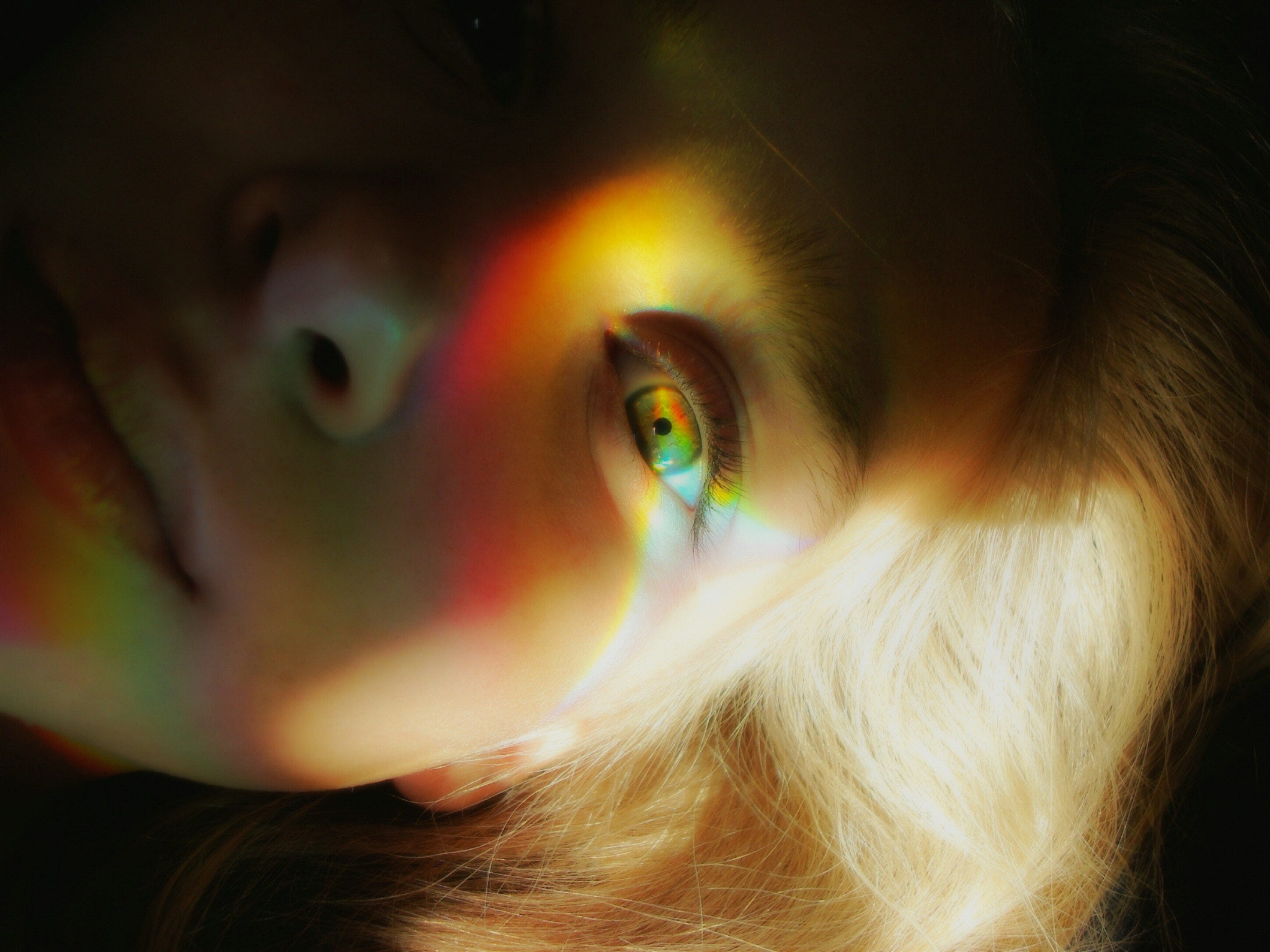
Your Brain Is Glowing—and Scientists Can’t Explain It
In a recent study published in iScience, researchers detected biophotons emitted by the human brain from outside the skull for the first time.
Not thermal radiation. Not background noise. Actual photons emerging from living neural tissue.
Senior author Nirosha Murugan, a biophysicist at Wilfrid Laurier University in Ontario, put it plainly:
“The very first finding is that photons are coming out of the head—full stop. It’s independent, it’s not spurious, it’s not random.”
Participants sat in total darkness while researchers measured both EEG activity and photon emissions. When people changed cognitive states—opening or closing their eyes, shifting tasks—the pattern of emitted light changed too.
The relationship wasn’t simple. More neural firing didn’t always mean more photons. Sometimes light detected over one brain region correlated with activity elsewhere. Sometimes it didn’t.
Which is exactly what makes it interesting.
The researchers coined a new term for this technique: photoencephalography—the optical cousin to EEG. Whether these photons do anything remains an open question. They could be metabolic exhaust. Or they could be part of a signaling system we don’t yet know how to read.
As one external reviewer noted, the essential question remains whether:
“UPEs are an active mechanism to alter cognitive processes or if UPEs simply reinforce more traditional mechanisms of cognition.”
For now, science is forced to sit with the discomfort of not knowing.
Light as Information, Not Illumination
The idea that living systems use light to communicate isn’t new.
In the 1920s, Russian scientist Alexander Gurwitsch observed ultraviolet emissions from dividing cells and proposed that organisms communicate via “mitogenetic radiation.” His work was controversial, then dismissed, then quietly resurrected decades later.
Physicist Erwin Schrödinger, in What Is Life?, supported the idea that living systems maintain order by importing it from the environment—specifically through energy and light. (Great essay on 75 years of What is Life? by science writer Philip Ball in Nature)
Later, physicist Herbert Fröhlich proposed that biological systems maintain coherence through ordered electromagnetic oscillations. This idea would later become foundational to theoretical physics.
We Don’t Just Eat Calories. We Eat Light.
Dr. Popp took it even further, suggesting that DNA itself may be a primary source of biophoton emission, creating what he described as a coherent, light-based regulatory web inside the body.
“The real task of food is not to transport calories… The real task is to order the system. And this is caused by photons.” —Fritz-Albert Popp, biophysicist (1938 – 2018) ALICE archive interview
Plants capture photons through photosynthesis and store that energy not just as calories, but as organized structure. When we eat plants—or animals that ate plants—we inherit that organization.
Food becomes informational.
Light becomes nutritional.
This reframes nourishment entirely: not as fuel alone, but as coherence transfer.
It also reframes health—not as the absence of disease, but as the maintenance of internal order.
There Is a Light That Goes Out
In controlled experiments using advanced photon-sensitive cameras, researchers in the department of physics and astronomy at the University of Calgary observed living mice emitting robust biophoton signals. When the mice died, the light rapidly faded—despite identical body temperatures.
The glow did not drift. It did not transform.
It simply stopped.
As one researcher noted, the results show that ultraweak photon emission:
“Is not just an imperfection… it’s really something that comes from all living things.”
Which raises the question no one can answer yet:
If life is luminous… what happens to that light when life ends?
Physics doesn’t have language for that. Yet.

What We Are Made Of…
Astronomer, author and science legend Carl Sagan (1934-1996) famously wrote:
“The cosmos is within us. We are made of star-stuff. We are a way for the universe to know itself.”
Modern architect Louis Kahn (1901-1974) echoed this from another angle:
“We are born of light. The seasons are felt through light. We only know the world as it is evoked by light.”
These weren’t metaphors dressed up as science. They were intuitions waiting for measurement.
Now the measurements are catching up.
We are electrical, yes.
Chemical, of course.
But we are also faintly, persistently luminous.
And that glow may be doing more than we think.
Beings of Light
If the body is an information network…
If light is a signaling medium…
If health is coherence and illness is noise…
Then the future of care—medical, emotional, ecological—may depend less on forceful intervention and more on subtle tuning.
Less chemical.
More resonance.
We are not just matter in motion.
We are events of light, briefly organized.
Longevity, it seems, is not just about preserving cells or slowing time, but about sustaining coherence—because as long as our inner light remains ordered, communicative, and alive, the human glow endures.
What else we are wandering…
✨ Chasing the light: The scientific pursuit continues
From validating the science to new diagnostics and therapies like Low-Level Light Therapy (LLLT) for wound healing, disease detection (cancer, neurological), and understanding cellular communication—leading universities and research centers around the world are investigating biophotons and light as healing and its role in regenerative medicine.
Shortlist of Institutions & Labs:
Wellman Center for Photomedicine (MGH/Harvard): World’s largest academic center for light’s effects on biology, developing new light-based diagnostics and treatments.
Washington University School of Medicine (St. Louis): Biophotonics Research Center (BRC) uses light for non-invasive imaging and disease understanding.
University of Calgary: Researchers successfully detected whole-body biophoton glows from living organisms, linking light emission to biological state.
International Institute of Biophysics (Neuss, Germany): Founded by Dr. Fritz-Albert Popp, it continues to be a key hub for biophoton research, with ties to researchers at Leiden University.

Craving more?
📘 Alice in Futureland books
🎧 Alice in Futureland podcasts
🧠 Alice in Futureland game Am I Mad?
Thanks for tuning in.
For more wanderings, become an Alice in Futureland subscriber—it’s free.
Invite your friends to this mad tea party and let’s see how many things we can learn before breakfast.
©2026 Alice in Futureland