

🍄 The Convergence Report
The end of separate mysteries.
🍄 AudioDose Alice on Sonic Mushrooms: Listen to Knowing
📘 Alice in Futureland books
🎧 Alice in Futureland podcasts; New episodes on consciousness with Dr. Federico Faggin
🧠 Alice in Futureland game Am I Mad?
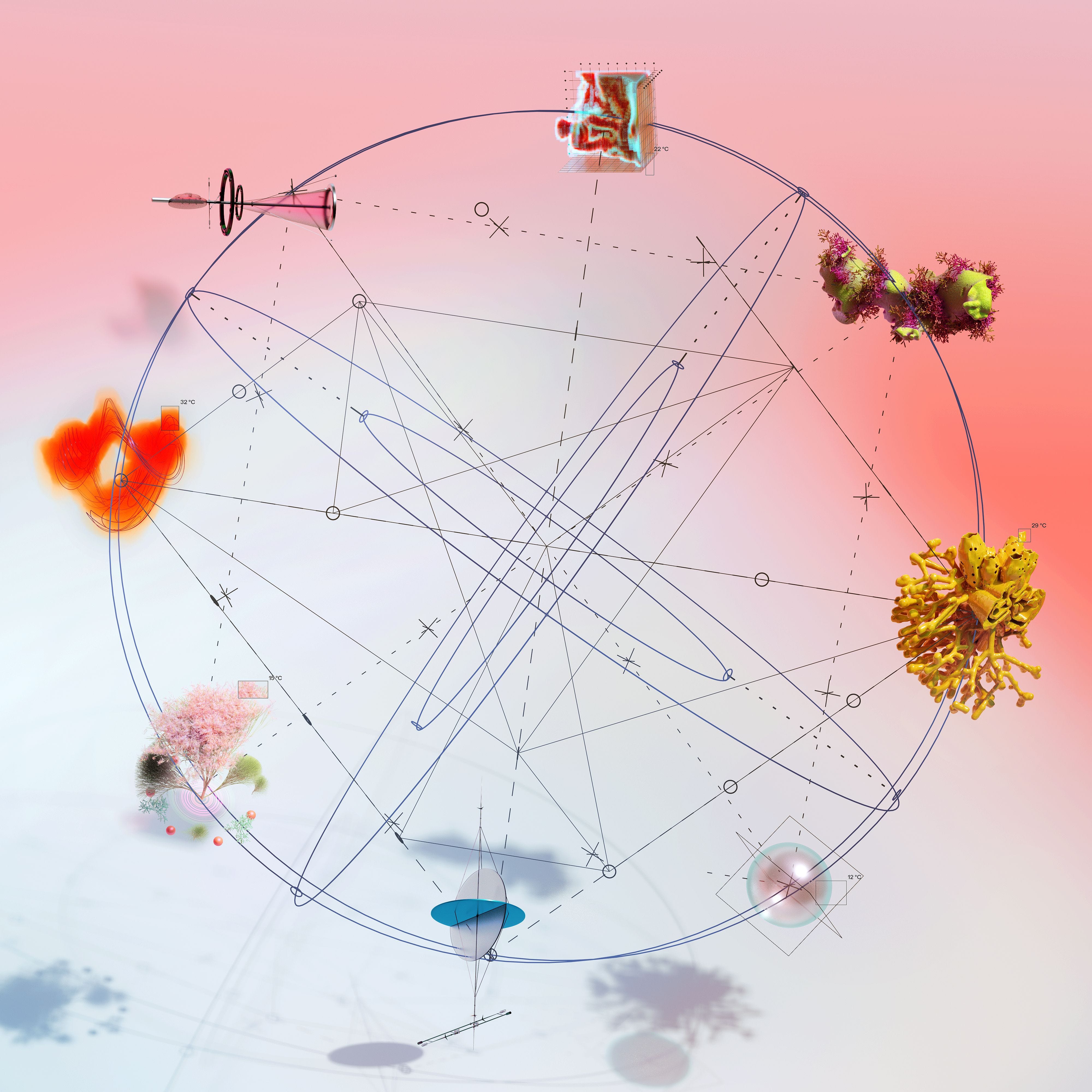
There is a saying among intelligence analysts: “If five independent sensors all begin reporting the impossible, stop questioning the sensors and start questioning your model.”
That is precisely where we find ourselves. Hello, we’re Alice and we are always in a state of wander. For decades, the world’s strangest questions occupied separate intellectual neighborhoods. UFOs belonged to aerospace. ESP belonged to fringe psychology. Quantum mechanics belonged to theoretical physics. Consciousness belonged to philosophers. Artificial intelligence belonged to computer science. Religion belonged to history. None of these communities spoke the same language.
Today they are beginning to describe the same landscape.
Not because anyone has proven extraterrestrials. Not because quantum mechanics “explains consciousness.” Not because psi has suddenly become accepted science. Rather, because every frontier discipline has independently collided with the same realization: Reality appears to be organized around information before it is organized around matter. Information may become one of the defining scientific ideas of the twenty-first century.
The Strange Attractor
The modern UAP conversation has quietly transformed. A decade ago everyone argued about photographs. Now researchers discuss ontologies. Government offices no longer spend most of their effort asking What is that object? Increasingly they ask, Why do these phenomena appear to interact with observers? The object is no longer necessarily the phenomenon.
The relationship may be.
Physicists studying quantum information arrive there. Neuroscientists studying predictive perception arrive there. Researchers investigating anomalous cognition arrive there. Complexity theorists arrive there. Artificial intelligence researchers arrive there. Each discipline believes it has discovered something unique. Viewed together, they resemble five blind cartographers describing the same continent.
Enter Paul Laffoley
In 2001, at an ALICE live event titled manTransform in NYC, artist-philosopher Paul Laffoley proposed something he called Utopic Space.
His argument was astonishingly contemporary.
He suggested humanity would eventually require an entirely new cognitive environment, a domain where science, theology, mathematics, art, philosophy, symbolism, and direct experience cease functioning as isolated disciplines and become one continuous epistemic field. Logic, he argued, is not the starting point of this space but an emergent property of entering it.
This was 2001. He wasn’t describing a better society. He was describing a better operating system for knowledge. Twenty-five years later, modern science appears to be wandering into exactly that terrain.
The Collapse of Silos
Every major breakthrough today happens between disciplines rather than inside them. We are living in a time of interstitial intelligence. We are on the brink of the Fifth Industrial Revolution. Biology merges with computation. Physics merges with information theory. Neuroscience merges with meditation research. Artificial intelligence merges with linguistics. Defense intelligence quietly consults cognitive scientists. UAP investigators cite complexity theory. Quantum physicists speak about observers. None of this was supposed to happen. Yet it has.
Civilizations don’t merely accumulate knowledge. Occasionally, they reorganize it. That reorganization is called “emergence”.
psi is no longer the right question
The twentieth century spent decades asking whether psychic phenomena were real. The twenty-first century is asking something more interesting. What sort of universe would naturally generate nonlocal correlations between conscious systems?
That is a scientific question. Not a religious one. Not a paranormal one.
An architectural one.
If consciousness is itself an emergent informational process, then anomalous cognition becomes less an exception to reality than a clue about reality’s deeper geometry. Whether current evidence ultimately confirms or rejects that hypothesis almost becomes secondary. The question itself has matured.
The New Noosphere
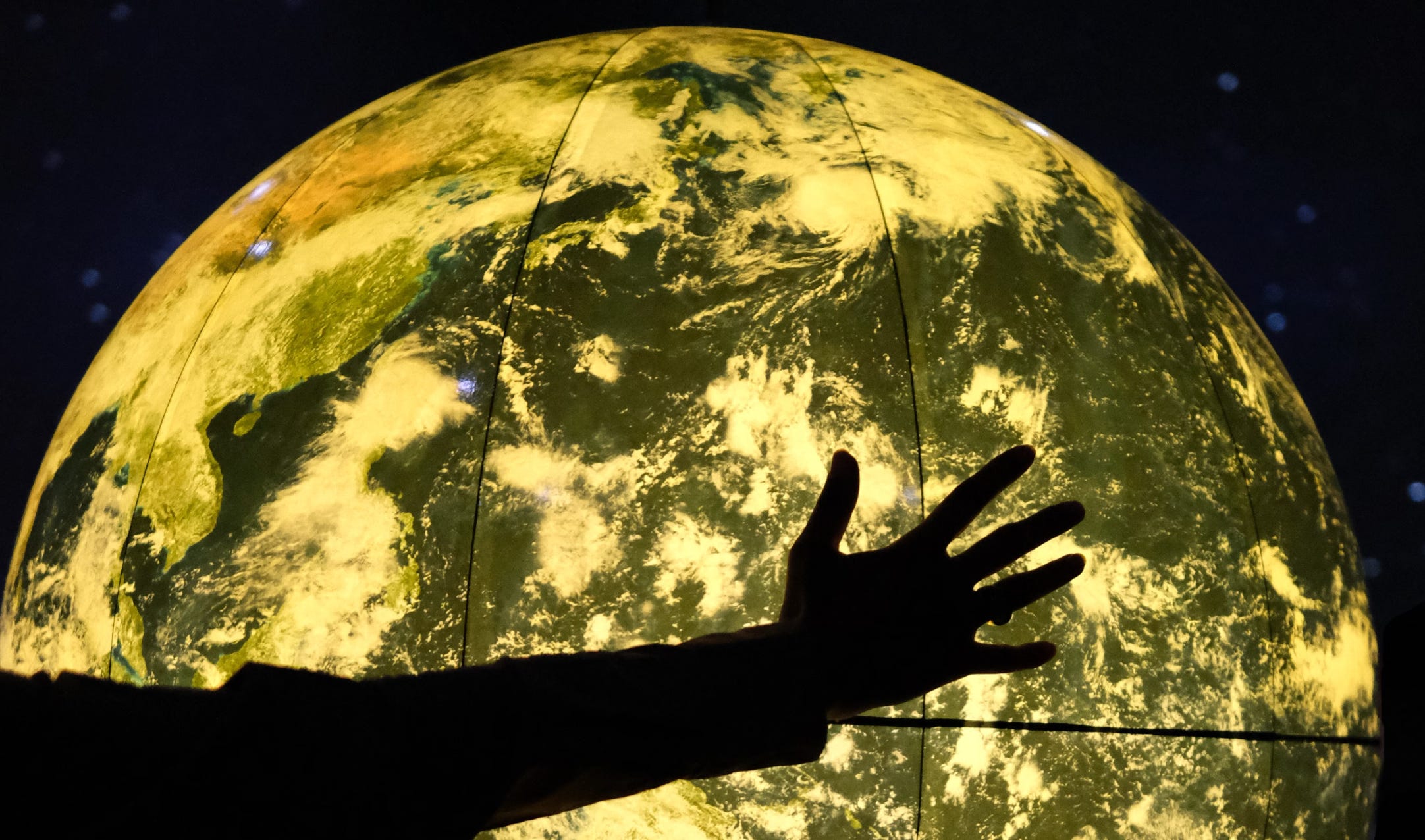
Teilhard de Chardin imagined a planetary layer of evolving intelligence surrounding Earth. When he wrote those words there were no satellites. No internet. No AI. No planetary sensor networks. Today every phone is a neuron. Every AI model becomes a cognitive amplifier. Every satellite contributes another sensory organ. Human civilization has unintentionally begun constructing something resembling a distributed nervous system.
The Noosphere was never mystical. It was developmental.
Perhaps the greatest limitation in Pierre Teilhard de Chardin’s otherwise visionary synthesis was not his understanding of evolution, but the boundary he placed around it. His Noosphere and Omega Point describe consciousness evolving toward increasing unity, yet they remain fundamentally Earth-centric.
As Paul Laffoley observed, Teilhard treated extraterrestrial intelligence as largely irrelevant to humanity’s spiritual destiny. That omission becomes increasingly consequential in an era shaped by serious inquiry into UAP phenomena, consciousness research, quantum information theory, and the possibility that intelligence itself is a universal property rather than an exclusively terrestrial one.
If consciousness is woven into the fabric of reality, as emerging work in quantum cognition, psi research, and non-local information increasingly suggests, then evolution cannot culminate solely within the biosphere of a single planet. The Noosphere may instead be understood as one node within a far larger cosmic ecology of minds.
Humanity’s evolutionary challenge is therefore not merely to converge with itself, but to learn how to participate within an already existing network of intelligences whose development may span planets, dimensions, and forms of embodiment. In that light, the Omega Point is transformed from the endpoint of human evolution into the beginning of humanity’s conscious participation in a genuinely cosmic civilization.
Beyond Disclosure
The biggest misunderstanding about UAP disclosure is that people expect revelation. History suggests something else. Every major scientific revolution begins with improved questions. Not improved answers. Copernicus did not merely move planets. Darwin did not merely classify species. Information theory did not merely improve telecommunications. Each changed the grammar through which civilization understood reality. The convergence now unfolding may represent another such grammatical shift. Not disclosure of visitors.
Disclosure of ontology.
The Signals
Pay attention when formerly isolated disciplines begin using the same metaphors. Networks. Fields. Information. Observers. Emergence. Resonance. Topology. Complexity. These are no longer specialized vocabularies. They are becoming the common language of frontier science. That is usually how paradigm shifts begin. Quietly. Long before the textbooks notice. And perhaps that is the real story of our moment. Not that humanity has encountered something alien. But that human knowledge itself is reorganizing into a higher-order pattern.
The phenomenon may be us.
Why Utopic Space Matters Now
Paul Laffoley wrote Utopic Space as more than a philosophical treatise, it is a blueprint for navigating periods of civilizational transition. At a time when artificial intelligence, quantum science, biotechnology, space exploration, and renewed investigations into consciousness are simultaneously reshaping humanity’s assumptions about reality, his central insight has become remarkably timely: the greatest breakthroughs do not emerge from isolated disciplines but from new architectures of meaning capable of integrating them.
Our culture is increasingly confronted with questions that cannot be answered by science, religion, politics, or philosophy alone.
The accelerating study of anomalous phenomena, non-local consciousness, UAPs, advanced computation, and complex systems suggests that the boundaries separating these domains are becoming increasingly porous. Whether or not every hypothesis ultimately proves correct, the cultural effect is already underway. The prevailing worldview of the Industrial Age, a universe composed of disconnected parts governed by linear causality, is giving way to one that recognizes networks, emergence, relationships, and information as fundamental organizing principles.
Laffoley’s concept of Utopic Space offers a language for this transition. Rather than proposing a single ideology, it describes a condition in which seemingly contradictory forms of knowledge can coexist without losing their individual integrity. In today’s terms, it is an operating system for convergence. A framework capable of holding physics alongside consciousness studies, engineering alongside spirituality, and empirical investigation alongside human meaning.
This shift has implications far beyond academic debate.
It suggests that the next great cultural transformation will not be defined primarily by new technologies, but by new capacities for collective intelligence. Institutions may become less hierarchical and more networked. Innovation may increasingly emerge through interdisciplinary ecosystems rather than isolated expertise. Education may evolve from memorizing information to cultivating systems thinking and pattern recognition. Even governance may begin to organize around adaptive intelligence rather than rigid bureaucratic structures.
If this trajectory continues, humanity’s next evolutionary step will not simply be technological enhancement but cognitive expansion: learning to perceive ourselves as participants in larger systems of intelligence that extend beyond nations, disciplines, and perhaps even beyond Earth itself. In that context, discussions surrounding consciousness research, UAP inquiry, and quantum information become culturally significant not because they offer definitive answers, but because they invite a broader conception of what intelligence, evolution, and civilization might become.
Laffoley ultimately reminds us that every civilization is organized around the stories it tells about reality. As those stories evolve, so too do our institutions, our technologies, and our sense of human possibility. Utopic Space therefore represents more than a vision of the future. It is an invitation to construct a culture capable of integrating complexity without fragmentation, embracing uncertainty without paralysis, and transforming discovery into wisdom. That may prove to be the defining cultural challenge of the twenty-first century.
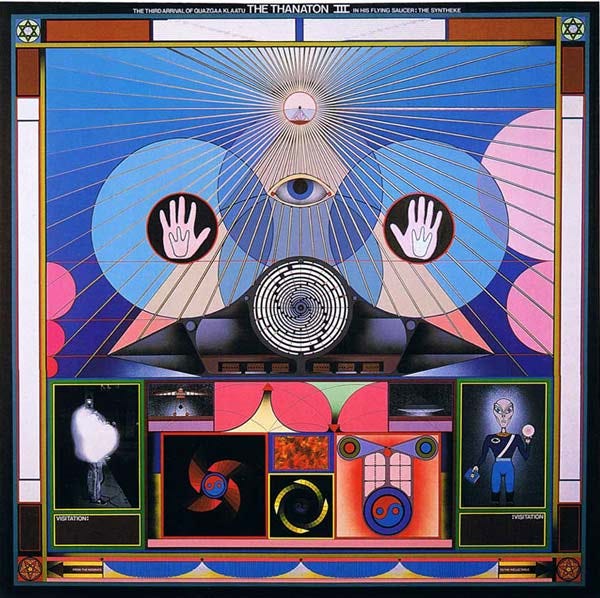
Thanaton III by Paul Laffoley
Perhaps the most fitting way to close this newsletter on Utopic Space is to remember that it was conceived by a man who insisted his work was not merely imagined but informed through direct encounters with extraterrestrial intelligence. Paul Laffoley described paintings such as Thanaton III as originating from instructions given by an alien presence, explaining how consciousness, and even the universe itself, could move into a fifth-dimensional realm. Whether viewed as literal experience, visionary insight, or symbolic revelation, these encounters formed the foundation of his “architectonic thought forms”: works intended not simply to be looked at, but to function as portals through which viewers might transcend ordinary space and time.
In an era increasingly willing to examine questions surrounding UAPs, consciousness, and non-human intelligence, Laffoley’s extraordinary body of work stands less as an eccentric curiosity than as an invitation to reconsider the boundaries of reality itself.
As the Fifth Industrial Revolution begins to fuse artificial intelligence, quantum technologies, biotechnology, and an expanded understanding of consciousness into a new cultural paradigm, Utopic Space emerges not as a relic of visionary speculation, but as a remarkably prescient map for navigating humanity’s next frontier.
Craving more?
📘 Alice in Futureland books
🎧 Alice in Futureland podcasts
🧠 Alice in Futureland game Am I Mad?
Thanks for tuning in.
For more wanderings, become an Alice in Futureland subscriber—it’s free.
Invite your friends to this mad tea party and let’s see how many things we can learn before breakfast.
©2026 Alice in Futureland
!!!!!!